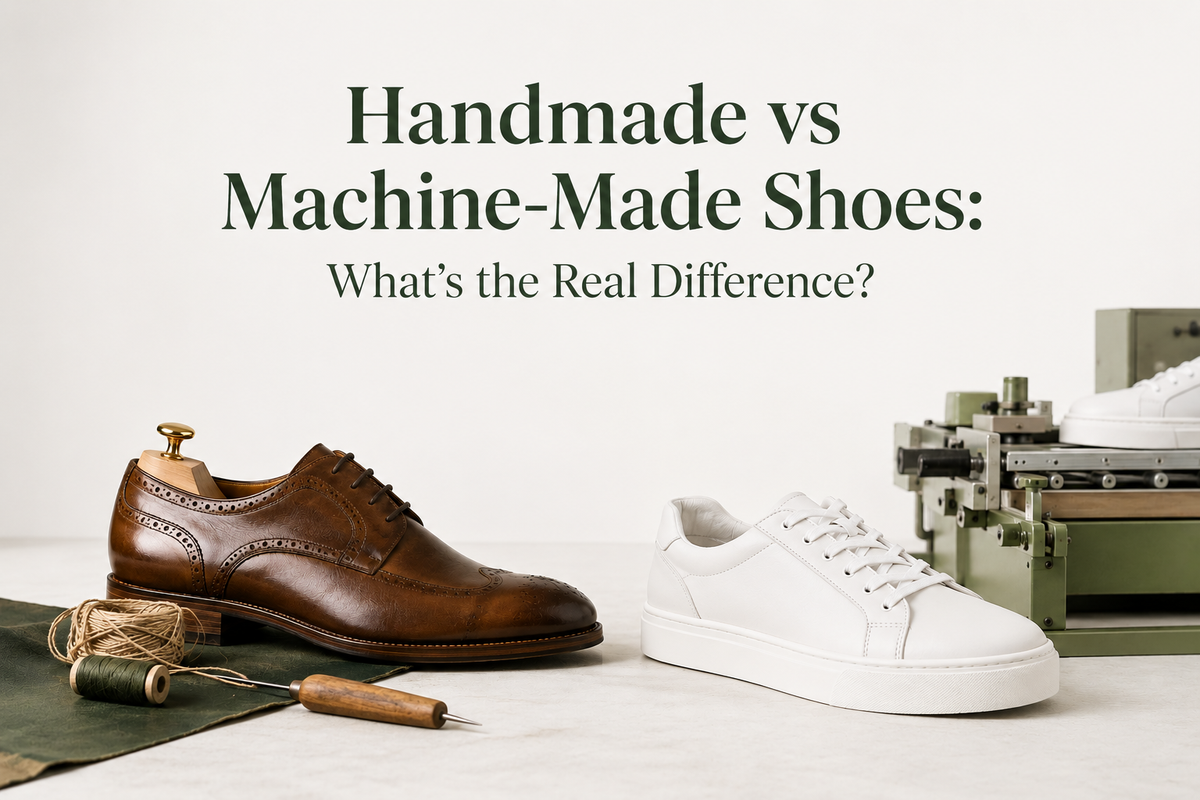
Handmade vs Machine-Made Shoes: What's the Real Difference?

If you've ever picked up two pairs of leather shoes that look almost identical but are priced hundreds of dollars apart, you've already run into this question. One says "handcrafted" on the box. The other doesn't say much at all. So what are you actually paying for?
The handmade vs machine-made shoes debate isn't just marketing talk. It comes down to real differences in how a shoe is built, how long it lasts, how it fits your foot, and whether you can fix it when it eventually wears out. Some of those differences matter a lot. Others matter less than shoe brands want you to believe. This guide breaks down exactly what separates the two, so you know what you're paying for the next time you buy a pair.
What Does "Handmade" Actually Mean?
The word gets used loosely, so it's worth being precise. A genuinely handmade shoe is cut, lasted, stitched, and finished largely by a single craftsman or a small team, using hand tools rather than automated machinery for the critical steps. The leather is often hand-selected, the stitching is done by hand or on manually guided equipment, and each shoe is inspected individually before it leaves the workshop.
This isn't a fast process. A single pair of genuinely handmade leather shoes can take anywhere from several days to a few weeks to complete, depending on the construction method and level of detail involved.
What Does "Machine-Made" Actually Mean?
Machine-made shoes are produced on automated assembly lines, using standardized lasts (the foot-shaped mold a shoe is built around) and pre-cut leather panels. Stitching, gluing, and sole attachment are handled by machines designed for speed and volume. A single factory line can turn out thousands of pairs a day.
This doesn't automatically mean poor quality. Plenty of respected, durable shoe brands use machine production for at least part of the process. But it does mean quality control works differently - defects are managed statistically, not caught individually, because the economics of mass production depend on volume.
Handmade vs Machine-Made Shoes: Quick Comparison
|
Factor |
Handmade Shoes |
Machine-Made Shoes |
|
Production time |
Days to weeks per pair |
Minutes per pair |
|
Quality control |
Individually inspected |
Statistical sampling |
|
Fit |
Often built on custom or refined lasts |
Built to a standardized average fit |
|
Materials |
Premium, hand-selected leather |
Varies - often synthetic blends |
|
Durability |
High, especially with welted construction |
Moderate, depends on construction |
|
Repairability |
Usually resoleable |
Often glued, harder to repair |
|
Price |
Higher upfront cost |
Lower upfront cost |
|
Uniqueness |
Slight natural variation, one-of-a-kind feel |
Fully uniform, identical pairs |
Construction Methods: Where the Real Difference Lives
The handmade-vs-machine debate really comes down to construction technique, not just labor.
Goodyear Welt Construction
This is the gold standard for durable leather shoes. A welt (a strip of leather) is hand-stitched or machine-stitched around the perimeter of the upper and insole, then the sole is attached to that welt rather than glued directly to the shoe. This allows a cobbler to remove and replace the sole multiple times without damaging the upper - meaning a well-built pair of wedding leather shoes or dress shoes can realistically last decades with proper care.
Blake Stitch Construction
Common in higher-end Italian shoemaking, this method stitches the sole directly to the insole and upper from the inside, creating a slimmer, more flexible shoe. It's still repairable, though it typically requires more specialized equipment than a Goodyear welt.
Cemented (Glued) Construction
The most common method in mass-produced, machine-made shoes. The sole is glued directly to the upper. It's fast, cheap, and works fine for casual or short-term wear, but it's rarely repairable - once the glue bond fails, the shoe is usually done.
Comfort and Fit: Does Handmade Really Feel Better?
This is where handmade shoes tend to have a genuine, measurable edge. Machine-made shoes are built on standardized lasts designed to fit an average foot shape reasonably well. That works fine for most people, most of the time.
Handmade shoes, especially from smaller workshops, are often built on lasts that are refined over time based on real foot data, or in some cases made-to-measure for the individual wearer. Combined with genuine leather uppers - which gradually mold to the shape of your foot as they're worn - this tends to produce a noticeably better long-term fit than a stiff, synthetic, assembly-line shoe.
That said, comfort isn't guaranteed just because a shoe is handmade. A poorly fitted handmade shoe can be just as uncomfortable as a poorly fitted machine-made one. Fit matters more than the label.
Durability and Repairability
This is arguably the most practical difference for anyone deciding where to spend their money.
-
Handmade shoes built with Goodyear welt or Blake stitch construction can typically be resoled multiple times, which means the upper - the most expensive and hardest-to-replace part of the shoe - can outlive several soles.
-
Machine-made shoes using cemented construction usually aren't built for repair. Once the sole separates or wears through, most people replace the whole shoe rather than fix it.
If you calculate cost-per-wear rather than just the upfront price, a well-made handmade pair often works out cheaper over a five-to-ten-year period than replacing a machine-made pair every year or two.
Cost: Why Handmade Shoes Are More Expensive
There's no getting around it - handmade shoes cost more, and the pricing reflects real inputs, not just branding:
-
Skilled labor hours, sometimes 8 to 20+ hours per pair
-
Higher-grade, often full-grain leather
-
Smaller batch sizes, which reduce economies of scale
-
Individual quality inspection at multiple stages
Machine-made shoes benefit from automation and volume, which is exactly why they can be sold at a fraction of the price. For everyday, budget-conscious footwear, that trade-off makes complete sense. For shoes you plan to wear for years - dress shoes, formal leather shoes, or a pair meant for important occasions - the math tends to favor handmade.
Sustainability Considerations
Handmade shoemaking, particularly from smaller workshops, tends to generate less waste per pair and often relies on more traditional, lower-impact tanning and finishing methods. Mass production, by contrast, is optimized for speed and cost, which can mean higher energy use and more synthetic material input per batch. If sustainability factors into your buying decision, it's worth checking a brand's material sourcing and production practices directly rather than assuming based on the handmade label alone.
So, Which One Should You Actually Buy?
Neither option is universally "better" - it depends on what you need the shoes for.
Choose machine-made shoes if:
-
You need something functional and affordable for everyday, high-turnover wear
-
You're not planning to keep the pair for more than a couple of years
-
Budget is the primary concern
Choose handmade shoes if:
-
You want a shoe that improves with age and molds to your foot
-
You value repairability and long-term cost efficiency
-
You're buying for a significant event - weddings, formal occasions, or professional settings where quality is noticeable
-
You want a shoe with genuine craftsmanship behind it, not just a label
If you're shopping for something that needs to look sharp and last, it's worth browsing a proper handmade leather shoes collection rather than defaulting to whatever's cheapest on the shelf. Brands like Cordwynn focus specifically on traditional construction methods - Goodyear welting, full-grain leather, and hand-finishing - built for people who want their shoes to actually last, not just look good for one season.
Depending on what you need them for, it's worth checking a few specific categories rather than browsing everything at once. If you're after everyday formal wear, a dedicated Oxford shoes collection or Derby shoes collection is a good place to start. For something more relaxed, a leather loafers range usually offers the same construction quality with a lot more versatility. And if you're building out a wardrobe for occasions like weddings or formal events, a men's wedding shoes section makes it easier to find pairs suited specifically to that level of formality.
Final Thoughts
The handmade vs machine-made shoes conversation isn't about one side being right and the other being a scam. Machine-made shoes serve a real purpose - they're accessible, consistent, and perfectly fine for casual, everyday use. Handmade shoes serve a different purpose - they're an investment in comfort, durability, and craftsmanship that pays off the longer you own them.
The real question isn't which one is objectively better. It's which one matches how long you actually want your shoes to last.
FAQ
Q1: Are handmade shoes really more comfortable than machine-made shoes?
Generally, yes, mainly because handmade shoes are often built on more refined lasts and use genuine leather that molds to your foot over time. But fit still matters more than the label - a poorly made handmade shoe won't feel great either.
Q2: Why are handmade shoes so much more expensive?
The cost reflects real inputs - skilled labor hours, higher-grade materials, smaller production batches, and individual quality inspection, none of which scale the way automated manufacturing does.
Q3: Can machine-made shoes be repaired like handmade ones?
It depends on construction. Machine-made shoes using cemented (glued) soles are usually hard to repair. Some machine-made shoes using Goodyear welt construction can still be resoled.
Q4: Is a handmade shoe always higher quality than a machine-made one?
Not automatically. Quality depends on materials and construction method, not just whether human hands were involved. A well-engineered machine-made shoe can outperform a poorly made handmade one.
Q5: How long do handmade leather shoes typically last?
With proper care and periodic resoling, a well-constructed handmade leather shoe can last well over a decade, sometimes decades, since the upper - the most valuable part of the shoe - stays intact through multiple sole replacements.