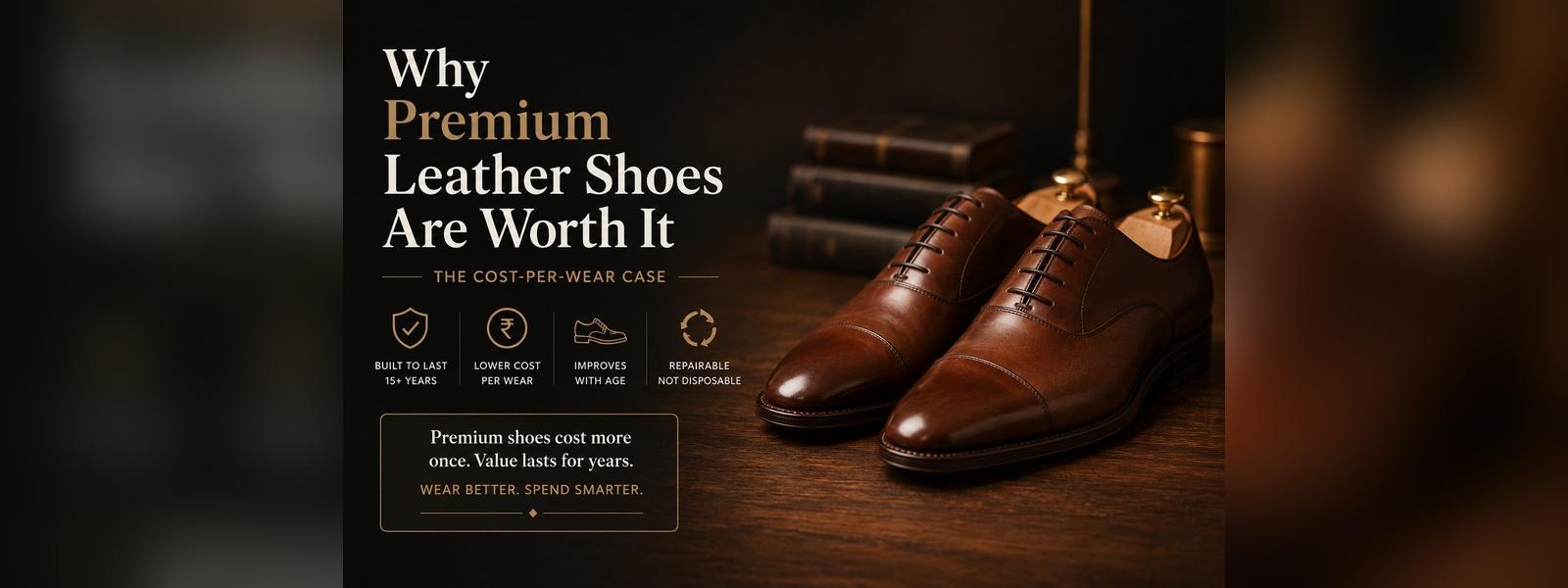
Why Premium Leather Shoes Are Worth It: The Cost-Per-Wear Case
You are standing in a shoe shop. One pair costs 25,000 rupees. Another looks similar and costs 5,000. The question seems obvious: why spend five times more?
The answer is cost-per-wear. When you run the numbers over 10 to 15 years, premium leather shoes cost less per wearing than budget alternatives. This guide shows you why, and what you are buying when you invest in quality footwear.
What Is Cost-Per-Wear?
Cost-per-wear is a straightforward formula:
Cost-Per-Wear = Total Purchase Price divided by Number of Times Worn
A 10,000 rupee shoe worn 500 times costs 20 rupees per wear. A 3,000 rupee shoe worn 80 times costs 37.50 rupees per wear. The more expensive shoe costs less each time you wear it. That is the entire argument, and the numbers support it.
The Numbers Over 15 Years
An office professional wearing dress shoes 4 days a week, 48 weeks a year, logs approximately 192 wears per year.
|
Budget Shoe |
Premium Shoe |
|
|
Purchase Price |
6,000 rupees |
28,000 rupees |
|
Lifespan |
18 months |
15 years |
|
Extra costs |
None (replaced) |
4 resoles x 3,000 = 12,000 rupees |
|
Total spend (15 yrs) |
39,000-42,000 rupees |
40,000 rupees |
|
Total wears |
Approx. 1,700 |
Approx. 2,880 |
|
Cost-per-wear |
22-25 rupees |
13.89 rupees |
|
Pairs discarded |
6 to 7 |
0 |
The premium shoe costs roughly the same over 15 years. The cost-per-wear is 40 percent lower. You discard zero pairs. The budget buyer discards 6 to 7.
What You Are Actually Paying For
The price difference between budget and premium leather shoes reflects a fundamentally different product, not a brand name.
Full-Grain Leather
The topmost layer of a hide is full-grain leather. It contains the tightest, most durable fibre structure. It breathes naturally, resists moisture, and develops a richer appearance over years of wear.
Budget shoes use corrected-grain or bonded leather. A split leather base gets coated with polyurethane to simulate the appearance of full-grain. The result looks similar at first but cracks and peels within 12 to 18 months. Full-grain leather ages better with every year of wear and care.
Goodyear Welt Construction
In a Goodyear welted shoe, the upper leather is stitched to a leather welt that runs around the perimeter. The outsole is then stitched to the welt. No glue holds the shoe together.
When the sole wears through, a cobbler cuts the stitching, removes the old sole, and stitches on a new one. The upper, lining, and structure stay intact. This process repeats multiple times across the life of the shoe.
Budget shoes use cemented construction. The sole is glued on. When it wears through, the shoe is finished. Resoling is not economical.
Leather Insoles and Lining
In a premium shoe, both the insole and the interior lining are leather. The insole compresses over weeks and months to take the exact shape of your foot. The fit improves with every wearing.
Synthetic linings in budget shoes trap moisture, break down with sweat, and begin peeling within 18 months.
Shoes That Improve With Age
Full-grain leather develops a patina. This is a natural sheen that builds through use, polishing, and the oils your foot produces. After 3 to 5 years of regular wear and maintenance, a pair of brown calf leather shoes shows a depth and richness that no new shoe replicates.
Budget shoes do not do this. Their surface coating prevents it. They deteriorate in appearance rather than improve.
A well-maintained 5-year-old pair of quality oxfords looks more distinguished than a new pair of budget dress shoes.
Resoling: The Key to Long-Term Ownership
Resoling is what separates a shoe that lasts 2 years from one that lasts 20.
A skilled cobbler with Goodyear welt experience replaces the outsole, renews the heel, and conditions the upper. The result is a shoe restored to near-new condition. The internal fit, shaped to your foot over years of wear, stays exactly as it was.
|
When the Sole Wears Out |
|
|
Budget shoe |
Buy a new pair at 6,000 rupees |
|
Premium shoe |
Resole at 2,500 to 5,000 rupees, keep the same shoe |
When seeking a cobbler for premium shoes, ask specifically about Goodyear welt resoling. Request to see previous work. A quality resole takes 1 to 2 weeks.
Which Premium Shoes Are Worth Buying
|
Tier |
Price Range |
Brands |
|
Entry-level premium |
15,000-25,000 rupees / 180-300 USD / 150-250 GBP |
Meermin, Loake 1880, Sanders |
|
Mid-range premium |
25,000-60,000 rupees / 300-750 USD / 250-550 GBP |
Carmina, Allen Edmonds, Cheaney, Paraboot |
|
Investment grade |
60,000+ rupees / 750+ USD / 600+ GBP |
Crockett and Jones, Tricker's, Gaziano and Girling, Edward Green, John Lobb |
How to Care for Premium Leather Shoes
After Every Wear
-
Insert cedar shoe trees immediately to absorb moisture and hold the shape
-
Brush off dirt with a horsehair brush
-
Allow at least 24 hours between wears
Every 2 to 4 Weeks
-
Apply a thin layer of leather conditioner
-
Allow 10 to 15 minutes to absorb
-
Buff with a clean horsehair brush
Every 4 to 8 Weeks
-
Apply wax polish in the appropriate colour
-
Work into the leather in circular motions
-
Buff to build shine
Every 3 to 5 Years
-
Resole with a cobbler experienced in Goodyear welt work
Frequently Asked Questions
Are expensive leather shoes worth it?
Yes, when the price reflects Goodyear welted construction and full-grain leather. The cost-per-wear maths, the comfort over time, and the longevity all support the investment.
How long should a good pair of leather shoes last?
With proper care and periodic resoling, 15 to 30 years. Many heritage British and European shoemakers have customers wearing shoes purchased 25 to 30 years ago.
What is the minimum price for a quality leather shoe?
Genuine Goodyear welted shoes with full-grain leather start at approximately 15,000 to 18,000 rupees (180 to 220 USD / 140 to 175 GBP). Below this price point, the construction quality required for long-term wear becomes difficult to find.
Is it better to buy one premium pair or two budget pairs for the same price?
One premium pair. You will wear them more, enjoy them more, and the cost-per-wear will be lower within 3 to 4 years.
Does brand name matter?
Heritage matters when the brand has refined its lasts and production methods over decades. Brand name alone, especially in luxury fashion, does not guarantee construction quality. Look at how the shoe is made, not who made it.
The Case Is Simple
A premium leather shoe made from full-grain leather with Goodyear welt construction will cost you less per wearing than any budget alternative within a few years. The fit improves over time. The appearance improves over time. The shoe remains repairable rather than disposable.
Buy one quality pair. Care for them properly. The investment pays for itself.