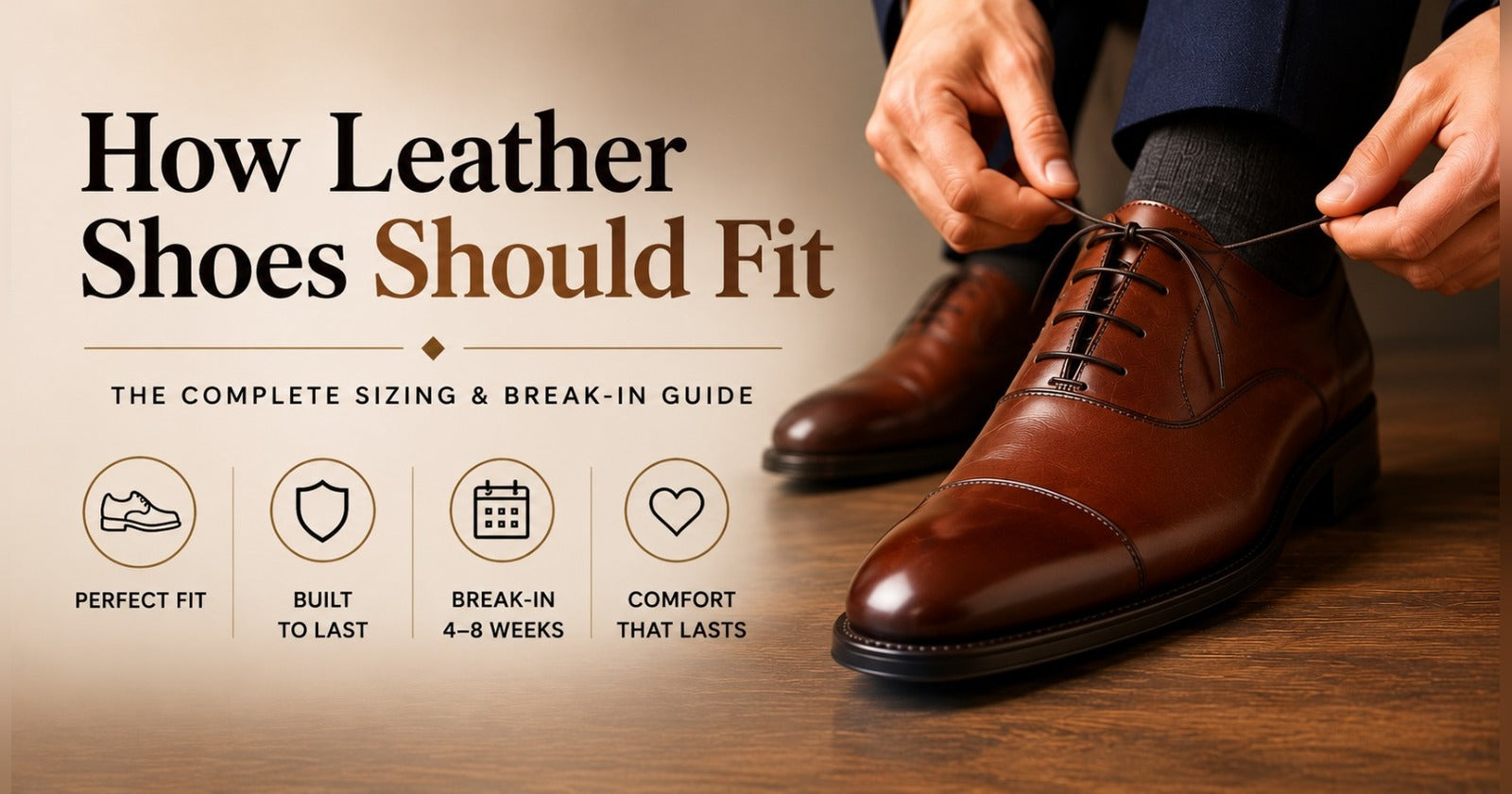
How Should Leather Shoes Fit? The Complete Sizing and Break-In Guide
Getting the fit right is the single most important decision you make when buying leather shoes. Most men get it wrong. They buy shoes that are too long, too narrow, or too stiff, then blame the shoes when the real problem was poor fit from day one.
This guide covers how leather dress shoes should fit at purchase, how the break-in period works, and how to tell the difference between a shoe that needs time and one that will never fit.
Why Leather Shoe Fit Works Differently
Leather is a natural material. Over time and with wear, quality full-grain leather softens, stretches slightly, and moulds to your foot. A shoe that feels firm on day one often becomes a precise, comfortable fit by week four.
Synthetic materials in sneakers do not do this. What you feel at purchase is what you get.
This changes how you assess fit in a shoe shop. A leather dress shoe should feel snug, not painful. If it feels perfectly broken-in the moment you try it on, the shoe is likely too large. It will grow loose with wear.
The Golden Rules of Leather Shoe Fit
-
Length comes first. Nothing else matters if the length is wrong.
-
Width matters as much as length. Most foot discomfort comes from incorrect width, not length.
-
The heel must grip firmly. Heel slip is common and correctable, but only when caught early.
-
Leave one thumb's width of toe clearance: 10 to 12mm between your longest toe and the end of the shoe.
-
Always fit your larger foot. Most people have one foot slightly bigger. Fit that one.
-
Shop in the afternoon. Feet swell throughout the day. Morning fittings often produce shoes that feel tight by evening.
How to Measure Your Feet
The Brannock Device, the metal measuring tool found in better shoe shops, measures three dimensions: overall foot length, arch length from heel to the ball of the foot, and width across the ball.
Arch length is often overlooked. Your foot's widest point must align with the widest part of the shoe. If it does not, you will feel pressure and discomfort regardless of overall length.
To Measure at Home
-
Place paper on a hard floor against a wall
-
Stand with your heel against the wall, full weight on your foot
-
Mark the end of your longest toe
-
Measure from the wall to the mark in millimetres
-
Compare against the brand's published size chart
How the Shoe Should Feel at Each Point
Toes
Leave 10 to 12mm of clearance. Toes should not press against the toe box, and they should not swim freely either. On pointed or chisel toe shoes, feel where your toe ends inside the shoe. The usable space ends well before the physical tip.
Ball of the Foot
The widest part of your foot must sit at the widest part of the shoe. Pinching or pressure across the metatarsals signals a width problem. Break-in will not fix this.
Heel
2 to 3mm of heel movement in a brand-new shoe is normal. It reduces as the insole compresses. More than 5mm of heel lift with each step means the shoe is too large or the wrong last for your heel shape. This will not fully resolve with wear.
Width
|
Width Code |
Description |
|
N or A |
Narrow |
|
M or D (men's) |
Standard |
|
W or E |
Wide |
|
XW or EE |
Extra wide |
If you regularly experience pain across the ball of the foot or blistering on the outer edge of your little toe, width is the problem, not length.
The Break-In Period
During break-in, the leather upper softens, the lining moulds to your foot, and the leather insole compresses to take your footprint. For Goodyear welted shoes with leather soles, expect 4 to 8 weeks of regular wear, 2 to 3 times per week. Blake-stitched shoes typically take 2 to 4 weeks.
How to Break In Leather Shoes Without Pain
Wear them in short sessions: Start with 1 to 2 hours per outing. Extend gradually. Do not force a full day on day one.
Use thick socks early: A heavier sock cushions your foot and gently stretches the leather during initial wear.
Condition the leather before first wear: A light application of a quality conditioner softens the leather fibres and speeds the process.
Use a wooden shoe stretcher: Insert overnight before your first wear to gently expand width and volume.
Apply moleskin to hot spots: If the heel counter or the side of the toe box causes blistering, protect the skin on your foot while the leather softens.
When Break-In Will Not Fix the Problem
Some fit issues will not resolve, no matter how long you wear the shoe:
-
Shoes that are too short: Leather stretches in width. Length stretch is minimal. If your toes press the toe box, the shoe is the wrong size.
-
Heel slip over 5mm: The shoe is too large or the wrong last for your heel. This will not fully correct with wear.
-
Sharp pain across the ball of the foot: A width problem. Go wider.
-
Shoes that feel loose from day one: Extra volume at first wear only increases with time.
Discomfort during break-in should feel dull and generalised, improving with each outing. Sharp, localised, or worsening pain after multiple wears signals a fit problem, not a break-in problem.
Frequently Asked Questions
Should leather shoes feel tight at first?
Firm, yes. Painful, no. Snug and structured is correct. Immediate discomfort or sharp pain signals a fit problem.
How much do leather shoes stretch?
Primarily in width: 3 to 5mm with regular wear and conditioning. Length stretch is minimal, 1 to 2mm at most.
Is heel slip normal in new leather shoes?
2 to 3mm is normal and reduces with break-in. More than 5mm suggests the shoe is too large.
Should I size up or down when between sizes?
Size down. Leather stretches. A shoe that is slightly snug is more likely to become comfortable than one that is slightly large.
Is it possible to stretch leather shoes at home?
Yes. Thick socks, leather conditioner, and a wooden shoe stretcher expand width by 3 to 5mm at home. For greater stretching, use a professional cobbler.
Get the Fit Right From the Start
Measure both feet. Try shoes on in the afternoon with your intended socks. Check length, width, heel grip, and toe clearance before you buy.
Slight firmness at purchase is expected. Pain is not. Invest time in finding the right fit, and your leather shoes will deliver years of comfortable, distinguished wear.